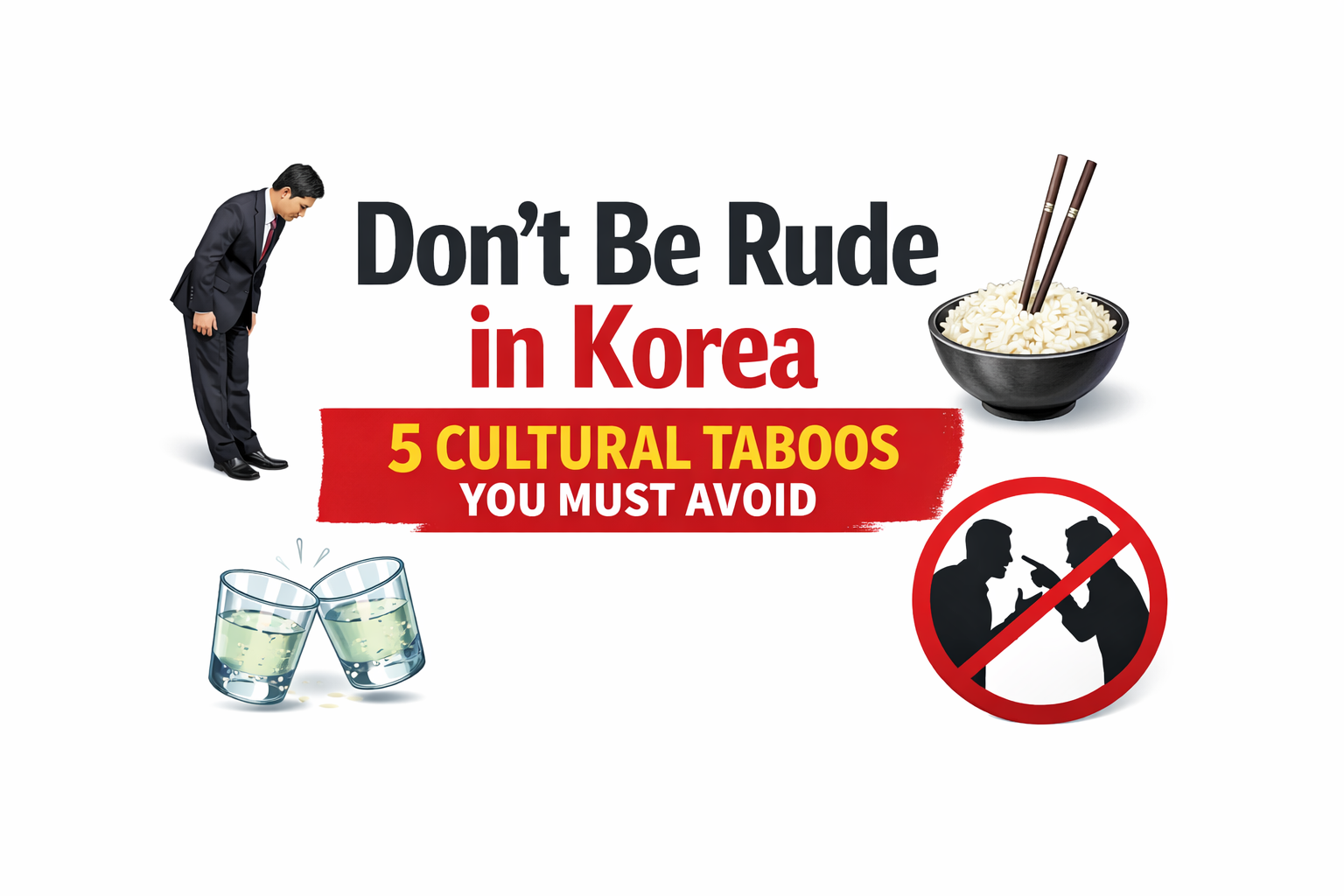
Korea's cultural etiquette (한국 문화 예절) is deeply rooted in hierarchy (위계질서), social harmony (사회적 조화), and respect for age (연장자 공경). Many foreigners living or traveling in Korea unintentionally commit cultural taboos (문화적 금기) — not from bad intentions, but from simple unawareness. This guide covers the 5 most critical Korean social etiquette rules that every foreigner must understand to avoid being perceived as rude in Korean workplaces, universities, and daily social settings.
Why Korean Cultural Etiquette Matters for Foreigners
Korean society operates on a framework of Confucian values (유교적 가치관) that places strong emphasis on order, respect, and group harmony. Unlike cultures that favor direct communication, Korean social interaction is shaped by indirect expression (간접 표현) and an acute awareness of others' emotions and status. For foreigners, this means that a well-intentioned comment or gesture can sometimes create unintended social tension.
The most important thing to understand is this: in Korea, social mistakes are rarely confronted openly. Instead, people may quietly withdraw trust or become less cooperative. Developing cultural awareness is therefore not about memorizing rules — it is about demonstrating genuine respect for the people around you.
The Role of "Face" (체면) in Korean Society
The concept of "face" (체면 — chemyeon) is central to Korean social dynamics. It refers to a person's dignity, reputation, and social standing. Actions that publicly embarrass or diminish someone — such as direct criticism in front of others or pointing out a mistake loudly — are considered serious social violations (심각한 사회적 결례). Awareness of this concept will help foreigners navigate both professional and personal relationships far more smoothly.
5 Korean Cultural Taboos Every Foreigner Must Avoid
Taboo 1 & 2: Age Hierarchy and Dining Etiquette
In Korea, age hierarchy (나이 서열) shapes how people speak, sit, and eat together. When meeting someone new, Koreans often ask your age early — not to be personal, but to determine the correct speech level (말투) to use. At the dining table, specific rules apply equally — breaking them signals a lack of cultural awareness even among well-intentioned foreigners.
| Situation | Do | Do Not |
|---|---|---|
| First Meeting (처음 만남) |
Use formal speech 존댓말 (jondaemal) until told otherwise |
Use casual speech 반말 (banmal) with anyone older or senior |
| Starting a Meal (식사 시작) |
Wait for the eldest person (어른) to begin eating first |
Start eating before the eldest person at the table |
| Chopstick Use (젓가락 사용) |
Rest flat on the chopstick holder or edge of the bowl |
Never stick upright in rice — this mirrors funeral ritual (제사) |
| Shared Dishes (공용 음식) |
Use the clean end of your chopsticks to serve from shared plates |
Use personal chopsticks directly from a communal dish |
| Rice Bowl (밥그릇) |
Leave the bowl on the table while eating |
Lift the rice bowl — unlike some other Asian cultures, this is improper |
Taboo 3 & 4: Drinking Culture and Saving Face
- When a senior pours a drink, accept with both hands and turn slightly away while sipping — this is a recognized gesture of respect (존중의 표현)
- To decline alcohol politely: place a hand over the glass or say "저는 됐어요 (Jeoneun dwaesseoyo)" — "I'm good, thank you"
- If alcohol is not possible, a brief explanation preserves harmony: "I'm unable to drink, but I'm very glad to be here" keeps the group atmosphere positive
- Never publicly challenge a senior's opinion in a meeting — raise concerns privately and indirectly afterward
- Avoid correcting someone harshly in front of a group — use phrases like "Perhaps we could also consider..." rather than direct disagreement
Taboo 5: Public Behavior and Personal Space
Korean public etiquette (공중 예절) is built on one core value: collective consideration (배려 — baeryeo). Quiet, orderly, and space-aware behavior is the unspoken baseline in subways, buses, cafes, and residential areas.
- Subway (지하철) / Bus (버스): No loud phone calls, keep music on headphones, speak in a low voice even with friends
- Physical contact: Avoid casual hugging or shoulder-touching with new colleagues or acquaintances — personal space is respected, especially with people met recently
- Escalators (에스컬레이터): Stand on the right, leave the left side open for those in a hurry
- Queuing: Always line up properly — cutting in line is taken seriously
- Eating while walking: Considered impolite — find a seat or a stationary spot instead
- Nose-blowing in public: Excuse yourself to do this privately; doing it openly is considered inconsiderate
Practical Etiquette Guide: Quick Reference for Daily Life
Cultural adjustment takes time, and no foreigner is expected to be perfect from day one. The goal is consistent awareness and a genuine willingness to respect local norms.
Based on My Mistakes
I still remember when I accidentally stuck my chopsticks upright in a bowl of rice during a team dinner in my first month in Korea. The table went noticeably quiet. A Korean colleague later pulled me aside, gently explaining that it resembles the incense sticks used at funerals and ancestral rites (제사). No one said anything during the meal — that silence was itself a lesson in Korean communication. It was embarrassing, but that one moment taught me more about Korean dining etiquette than any guidebook ever had.
Language Tips That Signal Respect
Even basic Korean phrases can significantly improve how foreigners are perceived. Using formal polite speech (존댓말 — jondaemal) is the default setting for all new relationships in Korea. Switching to casual speech (반말 — banmal) is only appropriate when explicitly invited by the other person, usually after building trust over time.
- "감사합니다 (Gamsahamnida)" — Formal "Thank you"; use this in all professional contexts
- "괜찮아요? (Gwaenchanayo?)" — "Are you okay?" — Shows care and social consideration
- "잘 부탁드립니다 (Jal butakdeurimnida)" — "I look forward to working with you" — Essential in workplaces and introductions
- "실례합니다 (Sillyehamnida)" — "Excuse me" — Use before asking a stranger for help
Settling into Korean Life: Practical Next Steps
Understanding cultural etiquette is just one part of settling into life in Korea. Practical logistics matter equally. For foreigners completing residency registration, the 2026 ARC Guide: 5 Common Mistakes That Will Reject Your Application covers the administrative errors that most affect new arrivals. Once registration is in order, knowing how to handle daily responsibilities — such as Korea's strict waste disposal system — becomes the next priority. The Ultimate Guide to Korea's Trash & Recycling Rules (2026) provides a complete breakdown of the rules that every foreign resident must follow.
Korea's cultural taboos (문화적 금기) are rooted in respect, not restriction. By understanding age hierarchy (위계질서), dining etiquette, group harmony, and public conduct, any foreigner can build genuine trust in Korean workplaces and social environments. Cultural awareness is the foundation that makes every other aspect of life in Korea more rewarding.


