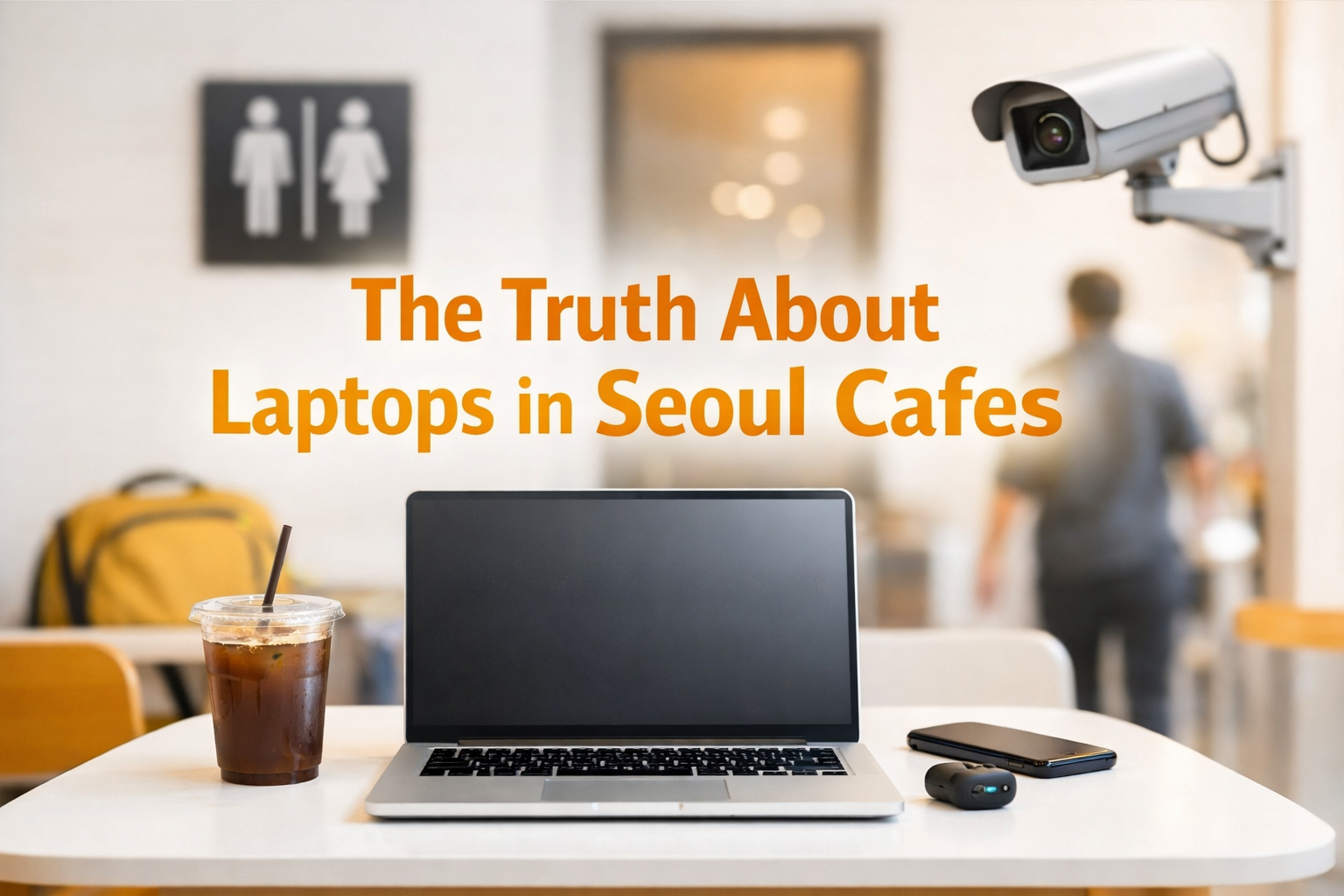
The first time I sat down in a Seoul cafe, the person at the next table stood up, left a MacBook, phone, and wallet sitting wide open on the table, and calmly walked toward the restroom. My instinct was to alert someone. Back home, that laptop would have been gone in thirty seconds. But nobody moved. Nobody even glanced at it. When the student returned five minutes later, everything was exactly where it had been left — untouched.
That single moment captures everything confusing and fascinating about Korea cafe culture for foreigners. Why do people practice leaving laptops unattended in Seoul cafes so casually? Is it genuine evidence that Korea is a safe country — or is it a local habit that visitors should never copy? After years of living and working from Seoul cafes, the answer turns out to be far more layered than it first appears. This guide breaks it all down: the social trust system behind the behavior, what the Korea safety statistics in 2026 actually say, and the specific situations where leaving any device unattended in a Korean cafe is genuinely risky — even today.
Key Takeaways
- Korean cafes function as extended workspaces — staying 2–5 hours with a laptop is standard practice, and leaving items on the table signals "I'll be right back" — a widely understood social code
- South Korea consistently ranks among the top countries for urban public safety in 2026, supported by one of the world's highest CCTV densities and strong social deterrents against public theft
- Risk increases significantly in tourist-heavy zones, outdoor seating, and after midnight — knowing when NOT to follow local behavior is essential for foreigners
Korea Cafe Culture: Why Do People Leave Laptops Unattended?
To understand Korea cafe culture, it helps to know that cafes in Korea are not simply coffee shops. They function as extended living rooms, study halls, and remote offices. In cities like Seoul, it is entirely normal for a customer to occupy a seat for 2–5 hours while working on a laptop — and cafe owners build their business model around this behavior.
The reason people practice leaving laptop in cafe Korea is rooted in convenience backed by a high level of social trust. Placing a bag or device on a table while stepping away is a universally understood "seat reserved" signal — it silently communicates that the person will return shortly. Staff and nearby customers recognize this code without any verbal exchange.
This behavior is supported by several structural factors that most foreign visitors are not aware of:
| Factor | What It Means | Impact on Behavior |
|---|---|---|
| Social Trust Culture | Collective responsibility norms make public theft socially devastating if discovered | High deterrent effect |
| CCTV Density | Korea has one of the highest urban CCTV ratios in the world — virtually all cafe interiors are monitored | Very high deterrent |
| Seat Reservation Signal | Unattended items visually communicate "occupied" — a widely accepted social shorthand | Practical daily norm |
| Community Density | Regular customers in residential neighborhood cafes create informal, mutual surveillance | Medium deterrent |
| Low Petty Crime Rate | Opportunistic theft in cafes is statistically rare compared to most major Western metropolitan cities | High — reinforces trust |
Insider Tip: On expat forums and Reddit Korea threads, one of the most common "first week in Seoul" surprises is watching locals walk away from MacBooks at busy Hongdae or Mapo cafes. This is not carelessness — in most residential neighborhood cafes, the social cost of being caught stealing far outweighs any potential reward. The informal community network inside these spaces acts as a powerful, invisible deterrent.
Is Korea Really a Safe Country? The Social Trust Factor
The phrase "safe country Korea" is frequently cited by travelers and long-term expats alike — and the data supports it. According to multiple international safety indexes, South Korea consistently ranks in the upper tier for urban safety among developed nations, with particularly low rates of violent crime and petty theft in city centers.
But the more important explanation goes deeper than statistics. Korean society places a high value on collective responsibility and public order. Social harmony and reputation matter significantly — stealing in a public cafe would not only be a criminal act, it would bring severe and lasting social shame if discovered. Combined with the dense CCTV networks and digital identity tracking systems that make post-incident identification highly probable, the perceived risk of committing theft is very high.
| Safety Factor | How It Works | What It Means for You |
|---|---|---|
| High CCTV Coverage | Every major street, building lobby, transit station, and cafe interior is monitored | Being identified after theft is highly likely |
| Social Stigma | Public theft carries severe reputational consequences in tight Korean social networks | Strong psychological deterrent for locals |
| Fast Urban Police Response | Seoul and major cities have relatively quick police response times in central areas | Reduces the window of opportunity |
| Low Anonymity in Neighborhoods | Residential cafes have regulars — unfamiliar behavior is noticed and remembered | Increases informal community monitoring |
| Digital Identity Tracking | Mobile-linked ID and payment systems make fully undetected crime significantly harder | Further discourages calculated theft attempts |
For foreigners planning to work long-term from Seoul cafes, Korea's public safety infrastructure is genuinely one of the strongest in Asia. If working remotely is the goal, understanding how to formalize the stay legally matters as much as knowing where to set up a laptop. The Korea Digital Nomad Visa (F-1-D) complete guide covers everything needed to make remote work in Korea official in 2026.
The Real Risks: When You Should NOT Leave Your Laptop
| Location / Situation | Risk Level | Main Reason | Recommended Action |
|---|---|---|---|
| Tourist districts (Myeongdong, Hongdae peak hours) |
High | High anonymity, heavy international foot traffic — informal surveillance disappears | Take everything with you; no exceptions |
| Large franchise cafe (crowded peak hours) |
Medium–High | Staff attention decreases with crowd density; items become less visible to employees | Ask staff to watch your bag; keep laptop in bag if leaving |
| Outdoor terrace seating | High | Limited camera coverage and open exit routes make identification and recovery difficult | Never leave valuables on outdoor tables unattended |
| After midnight (24-hour cafes) |
Medium | Customer profile changes at late hours; staff count typically reduced | Short breaks only; always take laptop with you |
| Residential neighborhood cafe (quiet hours) |
Low–Medium | Community familiarity effect is strongest here; regulars and staff recognize unusual behavior | Short restroom break under 3 minutes: lower risk. Longer: pack the laptop |
| University area cafe (study environment) |
Low | Students create a dense, informal community monitoring environment | Still keep laptop visible from restroom if possible |
Frequently Asked Questions
Q. Is it safe to leave my laptop in a Seoul cafe?
In a quiet residential or university-area cafe in Seoul, a brief absence of 2–3 minutes carries relatively low risk due to dense CCTV coverage and strong social deterrents against theft. However, in tourist-heavy areas like Myeongdong or outdoor terrace seating, leaving a laptop unattended is not safe for foreign visitors — the informal community monitoring effect that protects locals does not apply to unfamiliar faces.
Q. Why do Koreans leave phones and wallets on cafe tables?
Leaving personal items on a table is a widely understood "seat reserved" signal in Korean cafe culture. It communicates to staff and other customers that the person will return shortly. This behavior is reinforced by low opportunistic theft rates, ubiquitous CCTV systems, and the severe social stigma attached to public theft in Korean society — making the perceived risk of stealing very high for potential offenders.
Q. What should I do if I need to use the restroom in a Korean cafe?
The safest approach is to pack the laptop into your bag before stepping away, regardless of how brief the break. If carrying a bag feels inconvenient, placing it on the floor against the chair leg (less visible from the aisle) and choosing an indoor seat near the counter — where staff can see your belongings — significantly reduces risk. Never leave devices on outdoor terrace tables, even for a moment.
Conclusion: KimchiLandGuide's Verdict
Korea cafe culture reflects a unique social contract built on collective trust, one of the world's densest CCTV networks, and strong community norms. Understanding this system — rather than simply imitating it — gives foreigners a genuine advantage in daily life in 2026. Whether Korea is a safe country for leaving belongings unattended depends entirely on location, time of day, and duration. Cultural awareness is the most valuable tool. Knowing the system works far better than blindly copying local behavior.
Ready to explore Seoul's cafe scene in person? Seongsu-dong is Seoul's most vibrant creative district — packed with independent cafes, popup stores, and K-culture hotspots. Our sister blog TalkMaru has the complete Seongsu-dong Popup Store & Cafe Guide for 2026 to help plan the perfect day out in the city's most talked-about neighborhood.


