Korean Restaurant Etiquette Guide 2026: Spoon Setting, Ordering & No Tipping
Most visitors freeze the moment they sit down at a Korean restaurant — no utensils visible on the table, no waiter approaching, and leaving a tip ends with the server chasing them down the street. From the spoon and chopstick setting (수저 세팅) and Korea's table bell ordering system to the firm no tipping culture, this guide explains all three Korean dining rules every foreigner must know.
Spoon & Chopstick Setting (수저 세팅) Explained
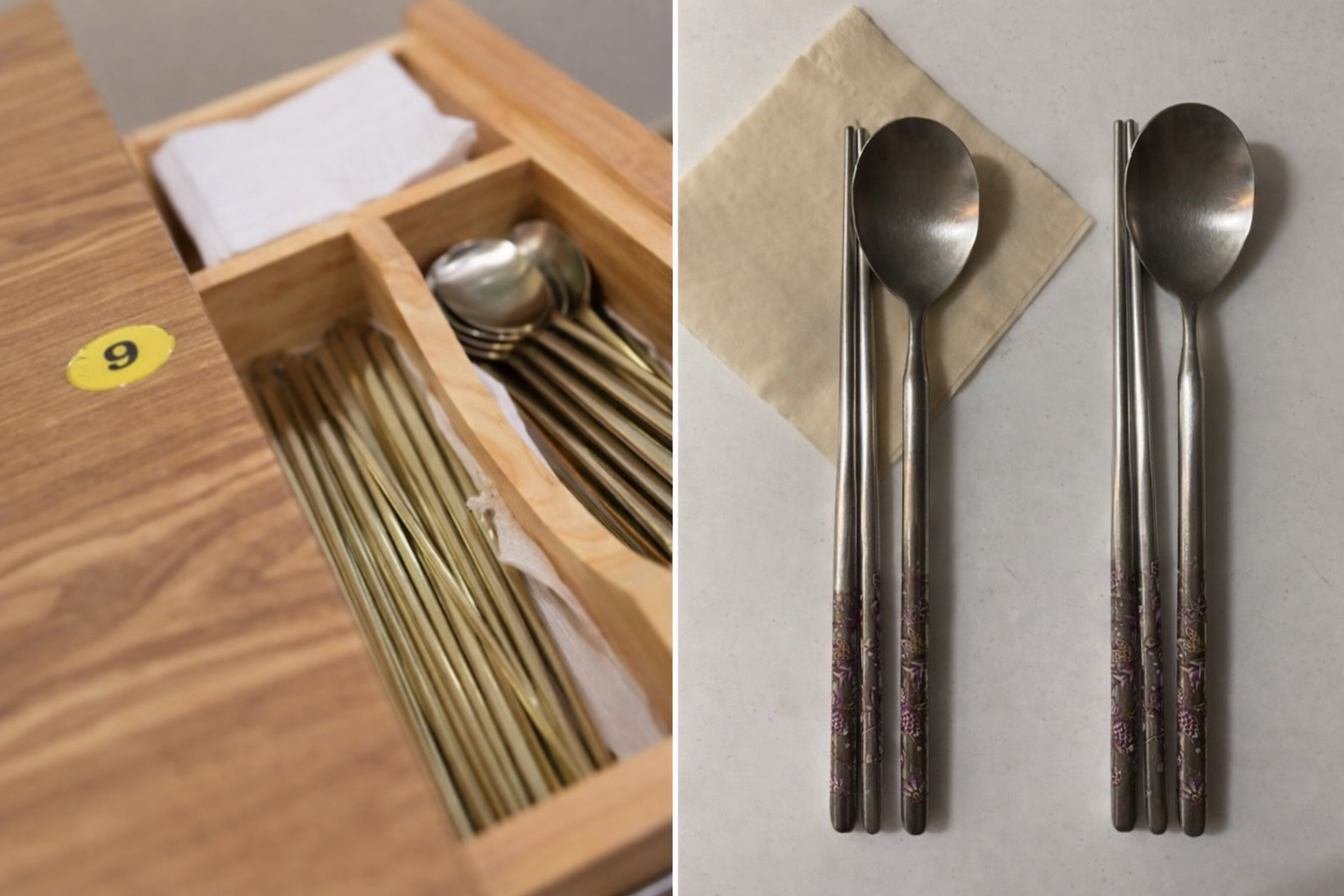
Korean restaurants use a metal spoon (숟가락, sutgarak) and metal chopsticks (젓가락, jeotgarak) — a pairing unique to Korea among Asian dining cultures. Unlike Western settings where cutlery is always pre-laid, many Korean restaurants — especially traditional diners — store utensils inside a small side drawer built into the table (서랍형 수저통) or in a cylindrical holder placed near the condiment tray. If no utensils are visible on the table, check the side drawer first before calling for staff.
Placement and Usage — Quick Reference
| Utensil | Korean Name | Used For | Key Rule |
|---|---|---|---|
| Spoon | 숟가락 (Sutgarak) | Rice, soup, stews, sauces | Rest to the left of chopsticks when not in use |
| Chopsticks | 젓가락 (Jeotgarak) | Side dishes, meat, vegetables | Never stick upright into rice — funeral connotation |
| Resting position | — | Mid-meal pause | Lay flat on the table, not across a bowl |
| Holding rule | — | Anytime | Use one utensil at a time — never both simultaneously |
Two gestures to avoid completely: Sticking chopsticks upright into a rice bowl directly mirrors a Korean funeral rite and signals deep disrespect at any dining table. Passing food chopstick-to-chopstick carries the same symbolic weight. Also, lifting a bowl to your mouth while eating — common in Japan or China — is considered impolite in Korea. Keep all bowls on the table throughout the meal and use the spoon to bring food up.
One cultural detail that surprises many first-time diners: when eating with Korean elders or senior colleagues, wait until the most senior person at the table picks up their spoon before starting. This practice — called 어른 먼저 (elders first) — is a core expression of Korea's age-hierarchy culture and requires no words, just awareness.
Real Experience: A very common first-timer moment in Seoul — sitting down at a 김치찌개 diner, scanning the bare table, and spending nearly ten minutes waiting for utensils that never appear. The spoon and chopsticks were inside the small wooden drawer on the side of the table (서랍형 수저통) the whole time. These table drawer utensils are standard in traditional Korean restaurants. Always check the side drawer or the cylindrical holder near the condiments before assuming something is missing.
How to Order Food in Korea: Buttons, Kiosks & Voice
Korean restaurants operate on an efficiency-first model: staff do not hover, check in, or approach the table unprompted. The customer initiates all contact when ready. There are three main ordering methods in use across Korea in 2026, and knowing which one applies to the restaurant at hand prevents long waits and the embarrassment of waving helplessly at a busy counter.
1. The Table Bell (호출벨) — Standard in Most Korean Restaurants
The majority of sit-down Korean restaurants — from local 순두부찌개 spots to mid-range galbi BBQ places — have a call button (호출벨) mounted on the table edge or attached to the wall beside the seat. Press it once when ready to order, when requesting refills, or when asking for the bill. A chime sounds at the counter and staff come directly to the table. There is no need to wave, shout, or make eye contact with passing servers.
In restaurants without a visible button, the phrase "저기요 (Jeogiyo)" — pronounced "juh-gi-yo," meaning roughly "Excuse me" — said at a normal indoor speaking volume is the correct way to flag a server. This is fully acceptable and never considered rude or demanding.
2. Self-Order Kiosks (키오스크) — Common in Chains Since 2023
Fast-casual chains and many modern Korean eateries have replaced counter staff with self-order kiosks (키오스크) at the entrance. Select menu items on the touchscreen, choose a payment method, and collect the receipt to bring to the table. Most major kiosks — including those at Lotteria, Mom's Touch, and Hansot Lunch Box — offer an English language option via a small flag icon at the top-right corner of the screen.
3. Ordering Method Guide
| Method | Where You'll Find It | What to Do | English Available? |
|---|---|---|---|
| Table Bell (호출벨) | Traditional restaurants, BBQ, pojangmacha | Press button once | Not needed |
| Voice (저기요) | Any restaurant without a bell | Say "Jeogiyo" calmly | Show phone menu as backup |
| Kiosk (키오스크) | Fast-casual chains, food courts | Select on screen, pay, collect receipt | Yes — flag icon, top-right |
| QR Code Menu | Trendy cafes, modern Korean restaurants | Scan QR on table, order via smartphone | Varies by restaurant |
At most traditional Korean restaurants, water, napkins, and extra utensils are available at a self-service corner (셀프 코너) near the wall. Crucially, free side dish refills (반찬 리필) are standard and unlimited. Simply press the table bell and point to the empty banchan dish, or say "더 주세요 (Deo juseyo)" — "more, please" — to any passing staff member. Asking for banchan refills is completely normal and expected — it is one of the most distinctive and generous parts of Korean dining culture.
Real Experience: At kiosk restaurants, tapping 포장 (Pojang / takeout) instead of 매장 (Maejang / dine-in) is the single most common ordering mistake — the entire meal gets bagged to-go even while already seated at a table. Always confirm 매장 on screen before payment. One tap, zero confusion.
When dining in a group, Dutch pay (각자내기) is the standard practice among Korean colleagues and younger generations. Most Korean restaurants allow split payments at the counter — let the cashier know the number of people paying separately before processing begins. Splitting individually at the register is far more common than splitting a single bill by card at the table. There is no need to calculate tips on top of a split bill — each person pays their exact share and walks out.
No Tipping Culture in Korea: Why and What to Do Instead
For visitors arriving from the US, Canada, Australia, or Western Europe, the no tipping culture in Korea is one of the most disorienting surprises. Tipping is not simply unnecessary in Korea — it can genuinely confuse and embarrass the staff receiving it. Understanding the structural reason behind this norm prevents an awkward exit.
Why Tipping Does Not Exist in Korean Restaurant Culture
Korean restaurant employees receive a fixed hourly or monthly wage (시급 / 월급) that does not depend on tips in any way. Menu prices already reflect the full cost of service and labor. Because service charges are built directly into the bill, adding extra money signals confusion about pricing — not a compliment. This is structurally different from the US tipping model, where servers rely on gratuity to supplement a low base hour


