Choosing the right SIM Card & eSIM in Korea is essential for staying connected, whether traveling short-term or settling long-term. This complete 2026 guide covers airport SIM pickup, prepaid eSIM activation, ARC-based contract plans, unlimited data packages, and common activation errors foreigners encounter. Understanding Korean mobile network options will save time, prevent costly mistakes, and ensure seamless connectivity for banking, navigation, delivery apps, and daily communication throughout the country.
Understanding SIM Card & eSIM Basics in Korea
South Korea operates one of the world's most advanced mobile infrastructures, providing nationwide LTE and 5G coverage in urban and rural areas alike. Three major telecom providers dominate the market: SK Telecom, KT, and LG U+. Each offers similar network quality, with SK Telecom holding the largest market share and slightly better coverage in mountainous regions.
A physical SIM Card is a small chip inserted into a phone's SIM slot, while an eSIM (embedded SIM) is digitally activated via QR code scan without any physical card. Most modern iPhones (iPhone XS and newer), Google Pixel (4 and newer), and Samsung Galaxy flagship models (S20 and newer) support eSIM technology. However, some region-locked or carrier-locked devices may not support eSIM activation in Korea, so verifying device compatibility before purchase is critical.
Korean mobile plans fall into two main categories:
- Prepaid SIM Card & eSIM – Designed for short-term visitors (3 to 30 days), available without identification requirements beyond a passport
- Postpaid Contract SIM – For long-term residents holding an Alien Registration Card (ARC), requiring identity verification and Korean address registration
Prepaid plans typically offer unlimited data with speed throttling after reaching a daily high-speed cap (usually 1-3GB per day at full LTE/5G speed, then reduced to 1-5Mbps). Contract plans provide stable unlimited 5G speeds and a Korean phone number (+82) necessary for banking apps, government verification systems, delivery services, and online shopping platforms that require domestic number authentication.
Best SIM Card & eSIM Options for Foreigners
The optimal SIM Card & eSIM in Korea depends on stay duration, visa status, and connectivity needs. Short-term tourists benefit most from prepaid options available at airports or online, while long-term residents with an ARC should consider contract plans offering better value and full-service features.
| SIM Type | Best For | Where to Purchase |
ARC Required |
Activation Time |
|---|---|---|---|---|
| Airport SIM Card |
Short-term tourists & immediate use |
Incheon Airport Gimpo Airport telecom desks |
No | 5-10 minutes |
| Online eSIM |
Instant activation before arrival |
Official telecom websites or global eSIM providers |
No | Immediate (QR scan) |
| Local Store Contract SIM |
Long-term residents & ARC holders |
SK/KT/LG U+ retail branches |
Yes | 30-60 minutes |
| MVNO Budget Plans |
Cost-conscious long-term users |
Online or convenience stores |
Sometimes | Varies |
Official telecom information is available through the Korea Tourism Organization Official Site. For comprehensive settlement guidance including mobile services, banking, housing, and legal procedures, refer to the Hi Korea Immigration Portal.
How to Buy and Activate SIM Card & eSIM in Korea
The activation process for SIM Card & eSIM in Korea depends on where and how the plan is purchased. For beginners, it is helpful to think in three simple paths: buying at the airport right after landing, buying an eSIM online before the trip, and signing a long-term contract after receiving an Alien Registration Card (ARC). Understanding the basic flow of each option reduces stress at the airport, prevents common errors, and helps secure stable internet and a working phone number from the first day in Korea.
Airport SIM Card Activation Process
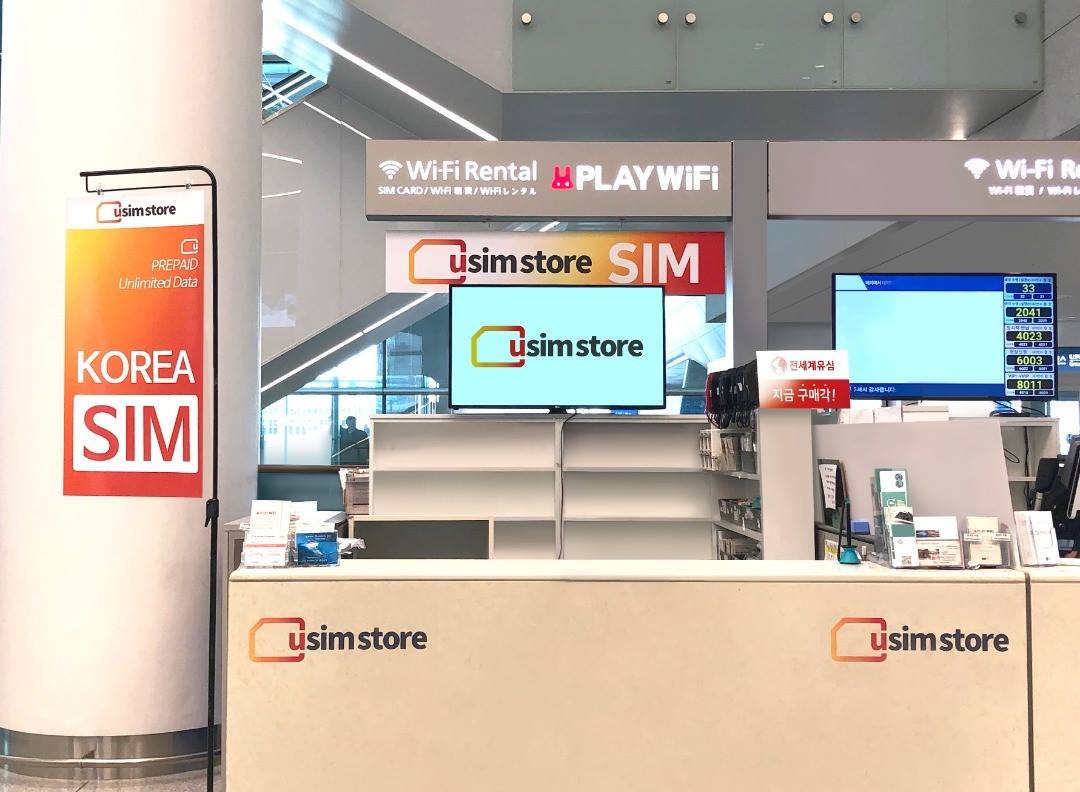
Airport SIM desks are located in the arrival halls of Incheon International Airport (Terminal 1 & 2) and Gimpo Airport, usually near the exit gates and information counters. At Incheon, booths from SK Telecom, KT, and LG U+ are placed close to the arrival gates and are open for long hours to serve incoming passengers. It is easy to find them by following signs that say “SIM / Wi-Fi / Roaming” after passing immigration and baggage claim.
The basic activation flow at the airport is very simple, even for first-time visitors:
- Step 1 – Take a queue ticket and wait: At many booths, there is a small machine where a waiting ticket must be taken. The screen above the counter shows the current number being served.
- Step 2 – Present passport and choose a plan: When called, hand over the passport and explain the length of stay (for example, 7 days or 30 days). Staff will recommend a prepaid plan with unlimited data for that period.
- Step 3 – Pay and insert the SIM: Pay in cash or by credit card. The staff removes the old SIM (if any), inserts the Korean SIM, and checks the network connection.
- Step 4 – APN and network test: Staff adjust APN (network) settings if needed and open a website or app to confirm data is working before the traveler leaves the counter.
Most airport SIM activations finish within 5–10 minutes, so it is realistic to complete everything before getting on the train or bus into the city. Airport pickup is strongly recommended for first-time visitors who are worried about language barriers, because staff do most of the technical work and can answer simple questions in English. For tourists, this is usually the fastest and least confusing way to get connected in Korea.
Online eSIM Activation Steps
Online eSIM is convenient for travelers who prefer to prepare before departure and do not want to handle a physical SIM card. After purchasing an eSIM from a Korean telecom or a global provider, a QR code and instructions are sent by email or shown in the user account. The eSIM is a digital profile stored inside the phone, so there is no need to physically change the SIM card.
For beginners, the eSIM activation can be broken down into simple stages:
- Before traveling: Purchase a South Korea eSIM plan online. Check that the device supports eSIM and is carrier unlocked. Locked phones from overseas carriers may not work with Korean networks.
- Download the eSIM profile: Connect to stable Wi-Fi, open the email, and scan the QR code using the phone settings.
On iPhone: Settings → Cellular (or Mobile Data) → Add eSIM → Use QR Code
On Android (Samsung/Pixel): Settings → Connections → SIM Manager / Network → Add eSIM → Scan QR Code - Label and prepare the eSIM: Many devices allow the eSIM to be given a name such as “Korea Data”. Keep the home-country SIM active for calls or SMS if needed, and set the Korean eSIM as the main data line.
- Enable the eSIM upon arrival: After landing in Korea, turn on the eSIM profile in the settings, enable data roaming for that profile if requested, and restart the phone so it can connect to a local Korean network.
Activation usually happens within a few minutes, but some eSIM plans only become active after the phone connects to a Korean network. This means that even if the eSIM profile is installed at home, data may not start working until the airplane lands and the phone searches for a local signal. Online eSIM providers include official Korean telecoms (SK Telecom, KT) and global travel data providers such as Airalo or Holafly, which offer Korea-only or Asia-wide data bundles. For users who are comfortable with basic phone settings and want to avoid standing in line at the airport, eSIM can be a very efficient option.
ARC-Based Contract Plan Registration
For people staying in Korea longer than 90 days, a Residence Card (formerly Alien Registration Card, ARC) is required for many everyday tasks, including signing up for a mobile phone contract. According to official guidance, long-term foreign residents must register for this card within 90 days of arrival at the local immigration office using the Hi Korea e-Government Portal to book a visit and check application requirements.
Once the ARC is issued, a proper Korean mobile contract can be opened. The typical process looks like this from a beginner’s perspective:
- Step 1 – Gather documents: Prepare the passport, ARC, and proof of Korean address (housing contract, dormitory certificate, or resident registration copy). In many cases, a Korean bank account or debit/credit card is also needed for monthly billing.
- Step 2 – Visit a telecom store: Go to a main branch or an authorized reseller of SK Telecom, KT, or LG U+. Some third-party shops also offer cheaper MVNO (budget) plans, which can be attractive for students and workers on a tight budget.
- Step 3 – Choose a postpaid plan: Staff explain available 4G/5G plans, including data limits, hotspot options, and discounts for long-term contracts or family bundles. Plans for heavy data users, students, or workers can differ, so asking simple questions is important.
- Step 4 – Identity verification and contract: The store checks the ARC and passport details, runs a basic internal check, and then prepares a contract in Korean. A simple English explanation is often available at stores in major cities. After signing, the SIM or eSIM profile is activated.
- Step 5 – Monthly billing setup: Billing is usually done by automatic withdrawal from a Korean bank account or by charging a Korean credit or debit card. A paper or electronic bill is issued each month with data usage and charges.
This contract-based number is then recognized as a fully verified Korean phone number, which is extremely important for real-name authentication in everyday life. It is used to log in to Korean banking apps, receive one-time passwords (OTP) for online payments, register for government and municipal services, and sign up for many popular platforms. For long-term residents who plan to live, study, or work in Korea, upgrading from a simple prepaid SIM to a postpaid contract after receiving the ARC is a key step toward stable digital access and smoother daily life in Korea.
SIM Card & eSIM Price Comparison & Data Plans
Pricing for SIM Card & eSIM Korea plans varies by duration, data allocation, and provider. Below is a realistic comparison of prepaid tourist plans as of February 2026.
| Plan Duration |
Data Allowance |
Speed After Cap |
Approx. Price (USD) |
Voice/SMS Included |
|---|---|---|---|---|
| 3 Days | Unlimited (1GB/day high-speed) |
1-3 Mbps | $15–$20 | Limited (100 min) |
| 5 Days | Unlimited (2GB/day high-speed) |
1-3 Mbps | $20–$28 | Limited (100 min) |
| 7 Days | Unlimited (2GB/day high-speed) |
1-5 Mbps | $25–$35 | Limited (200 min) |
| 10 Days | Unlimited (3GB/day high-speed) |
3-5 Mbps | $32–$42 | Often included |
| 30 Days | Unlimited (5GB/day high-speed) |
5 Mbps+ | $45–$60 | Yes |
Long-term contract plans for ARC holders typically range from $40–$70 per month depending on 5G data allowance, device installment payments, and bundled services (streaming, cloud storage). Family plans with multiple lines offer 20-30% discounts per additional line. Contract plans include full-speed unlimited data without throttling, priority network access during congestion, and number portability when switching carriers.
Long-Term SIM Card & eSIM for Residents (ARC Holders)
Foreigners holding an Alien Registration Card (ARC) qualify for contract-based SIM Card & eSIM Korea plans offering superior benefits compared to prepaid tourist options.
Key advantages of contract plans include:
- Korean phone number (+82) required for banking app verification, online shopping, food delivery services, and government portal authentication
- Unlimited 5G data speeds without daily throttling or speed caps, crucial for video streaming, remote work, and large file transfers
- Family plan discounts offering 20-40% savings when adding multiple lines under one account
- Number portability (MNP) allowing users to keep the same phone number when switching between SK Telecom, KT, and LG U+
- Device installment plans spreading smartphone costs over 24-30 months with 0% interest
- International roaming packages at discounted rates for travel outside Korea
Required documents for contract plan registration include a valid passport, Alien Registration Card, proof of Korean address (housing contract or resident registration), and Korean bank account for automatic billing. Telecom stores verify visa category and may request employment verification for certain visa types (E-7, D-2, etc.). Processing takes 30-60 minutes, with same-day activation in most cases.
Common Problems with SIM Card & eSIM & Solutions
Foreigners frequently encounter specific technical issues when activating SIM Card & eSIM in Korea. Understanding these problems and their solutions prevents connectivity delays.
Most common activation issues:
- Device not eSIM compatible – Verify eSIM support in phone settings before purchasing. Older iPhone models (prior to XS), budget Android phones, and region-locked devices often lack eSIM functionality
- QR code activation failure – Ensure stable Wi-Fi connection during eSIM download. Restart device if QR scan repeatedly fails, or manually enter activation code provided by the carrier
- APN configuration errors – Some devices require manual APN settings. Contact carrier customer service for exact APN values (SK: lte.sktelecom.com, KT: lte.ktfwing.com, LG U+: internet.lguplus.co.kr)
- No signal immediately after arrival – Airport basements and underground train stations have weak signal. Wait until reaching ground level or outdoor areas for network registration to complete
- Carrier lock preventing activation – Phones purchased through US carriers (AT&T, Verizon, T-Mobile) may have carrier locks. Contact original carrier to request international unlock before traveling
- Prepaid plan not activating – Some plans only activate when physically in Korea and connected to a Korean cell tower. Activation may take 5-30 minutes after landing
Most issues resolve by manually configuring APN settings or restarting the device after SIM insertion. For persistent problems, visit a telecom retail store with passport and purchase receipt for technical support. English-speaking customer service is available at major telecom branches in Seoul, Busan, and near international airports.
Final Decision: Which SIM Card & eSIM in Korea Should You Choose?
Selecting the right SIM Card & eSIM in Korea ensures uninterrupted connectivity for navigation, banking, communication, and daily services. Short-term visitors staying less than 30 days should choose prepaid airport SIM cards or online eSIM plans for convenience and immediate activation. Long-term residents with an ARC benefit most from contract plans offering Korean phone numbers, unlimited 5G speeds, and family discounts. Always verify device compatibility, carrier unlock status, and plan activation requirements before purchase to avoid connectivity issues upon arrival.


