Korea March Weather 2026: Why You Still Need a Light Padded Jacket
March weather in Korea 2026 surprises most visitors. Despite being a spring month, Seoul's near-freezing mornings, wide daily temperature gap, and dry continental winds make a light padded jacket essential — not optional. This guide covers Korea's layering strategy and what to wear in Korea in March for both men and women.
Key Takeaways
- Early March mornings in Seoul regularly drop to 0–3°C — a light padded jacket is the most practical outer layer for the full day.
- The daily temperature swing of 10–14°C (cold morning → mild afternoon → cool evening) demands layering, not a single spring outfit.
- Spots like Yeouido Hangang Park, Namsan, and Gyeongbokgung all require insulated outerwear even in mid-March due to open-air wind chill.
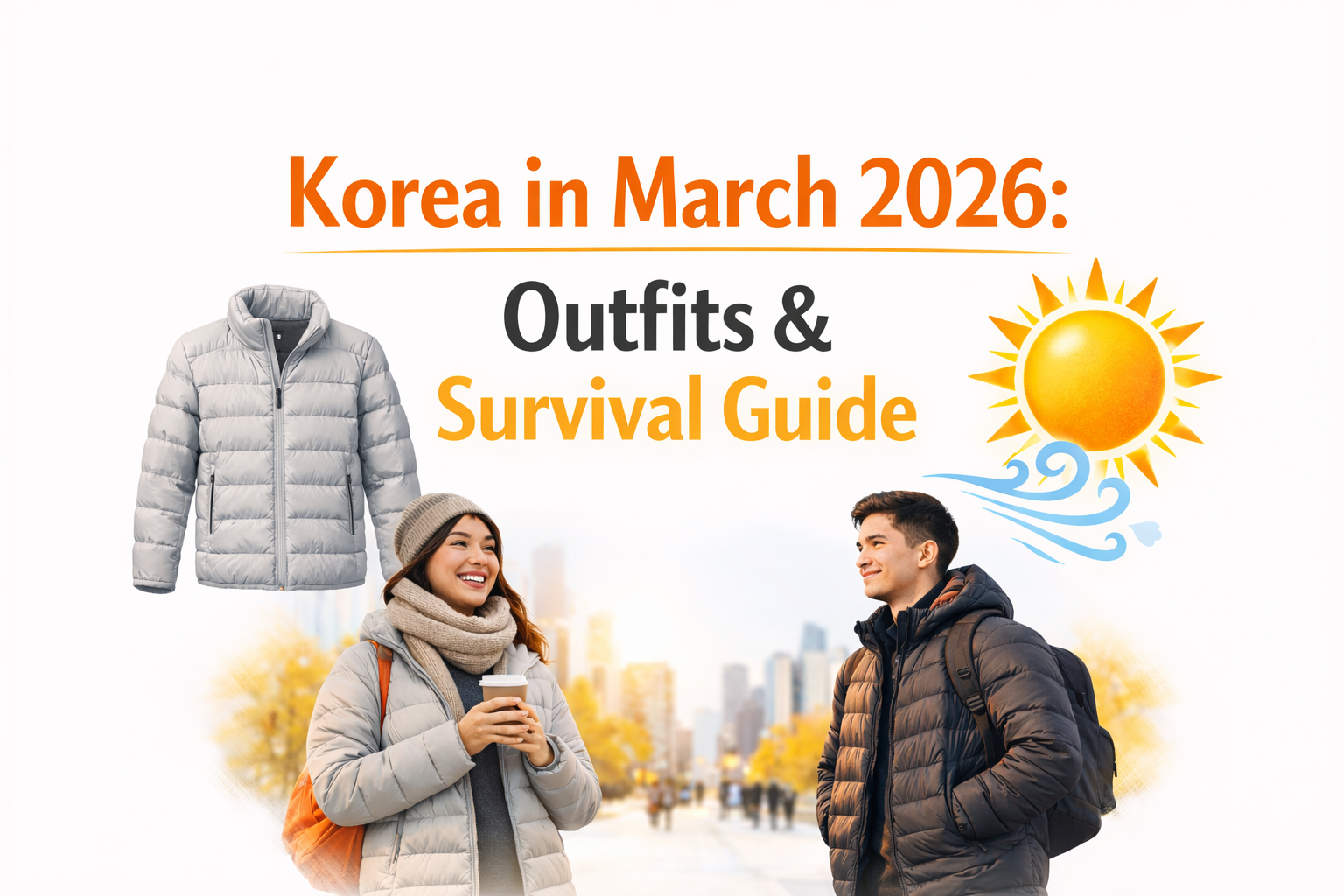
Seoul in March 2026 — light padded jackets remain standard outerwear even as cherry blossoms approach.
Why March Weather in Korea Feels Colder Than You Expect
Looking at a weather app, the average daytime temperature in Seoul during March reaches around 10–14°C (50–57°F) — which sounds manageable. The problem is not the midday reading. It is the dramatic temperature swing within a single day that catches most visitors completely off guard.
In early March, morning temperatures regularly drop to 0–3°C (32–37°F). When dry air and spring wind are factored in, the perceived (feels-like) temperature can fall several degrees lower than the actual number. This is called wind chill — a simple concept: the faster the wind blows across exposed skin, the colder it feels, even if the thermometer hasn't changed.
This effect is especially noticeable at specific outdoor locations that foreigners commonly visit in March. At Yeouido Hangang Park, the wide open riverbank channels the Han River wind directly — making 5°C feel closer to 1°C when walking near the water. On Namsan, temperatures at the summit are consistently 2–4°C colder than street level in downtown Seoul, and the night visit experience (N Seoul Tower area) after 6 PM can feel bitterly cold even when daytime was mild. At Gyeongbokgung Palace, the large flat courtyards amplify the exposed wind with no shelter from buildings, which makes extended outdoor sightseeing in a thin spring jacket noticeably uncomfortable, especially in the morning.
Common Mistake: Many visitors check only the "average temperature" for March in Korea and pack spring clothes. That average hides the 0–5°C mornings and sharp evening drops. Always check the daily low temperature — not just the average — before packing.
Korea has a continental climate — cold air masses from the north still push into the Korean Peninsula during early spring. Even when afternoon sun warms things up, temperatures fall sharply after sunset. By 6–7 PM at outdoor areas like Cheonggyecheon Stream or the alleys of Insadong, it can feel like mid-February again. This daily pattern of warming and cooling is consistent every March.
For most visitors in Seoul, the daily temperature gap of 10–14°C within a single day is the biggest challenge when deciding what to wear. Once dressed and ready to explore, knowing how to get around efficiently is the next priority. The K-Pass Korea Transport Guide on KimchiLandGuide shows how foreigners can save up to 53% on Seoul public transport.
Why a Light Padded Jacket Is Necessary in Korea
A light padded jacket — also called a thin down jacket, quilted jacket, or lightweight puffer — is the most practical outer layer for March in Korea. It fills the critical gap between a heavy winter parka (too warm by midday) and a simple trench coat or spring jacket (too thin in the morning and evening).
Here is a straightforward way to understand why it works: a light padded jacket acts as a thermal buffer. It traps body heat without causing overheating during mild afternoon hours. Most models weigh under 500g and can be folded into a bag when not needed — a real advantage when temperatures shift by 10°C within the same day.
| Outer Layer Type | Morning (0–5°C) | Afternoon (10–14°C) | Evening (5–8°C) | Overall Verdict |
|---|---|---|---|---|
| Heavy Winter Parka | Warm | Too Hot | Warm | Too Bulky |
| Light Padded Jacket | Warm (with layers) | Comfortable | Warm | Best Choice |
| Trench Coat (unlined) | Cold | Comfortable | Chilly | Risky |
| Thin Spring Jacket | Too Cold | Comfortable | Cold | Not Recommended |
Insider Tip: Korean locals commonly layer a heat-tech base layer (widely available at Uniqlo stores across Seoul) under a light padded jacket during early March. This combination handles 0°C mornings and 14°C afternoons without needing to carry extra clothing — and is especially valuable during long outdoor visits to places like Gyeongbokgung or evening walks along Yeouido Hangang Park.
A lined trench coat or thick cardigan becomes a reasonable option in late March (after the 20th), when morning temperatures begin stabilizing above 5°C. However, for early to mid-March, the light padded jacket remains the most reliable choice based on Seoul's consistent weather patterns year over year.
What to Wear in Korea in March — Men & Women Guide
The core principle for March outfits in Korea is layering from the inside out. Clothing must work across at least three temperature zones within a single day: cold morning, mild afternoon, and cool evening. Building outfits around this three-zone structure — rather than dressing for just one time of day — is what separates comfortable visitors from cold ones.
| Layer | Men's Recommendation | Women's Recommendation |
|---|---|---|
| Base (Inner) | Long-sleeve T-shirt or thermal undershirt | Heat-tech top or fitted long-sleeve shirt |
| Mid Layer | Knit sweater, hoodie, or fleece | Cardigan, knit sweater, or light turtleneck |
| Outer Layer | Light padded jacket or quilted coat | Light padded jacket or quilted coat |
| Bottom | Jeans or thick-fabric trousers | Jeans, tailored pants, or skirt with thermal tights |
| Footwear | Sneakers or leather shoes (avoid thin canvas in early March) |
Ankle boots, loafers, or sneakers |
| Accessories | Light scarf (especially early March) | Light scarf or thin knit beanie (early March) |
Men's March Outfit — Key Points
The most common mistake for men is wearing only a single outer layer without a proper mid layer underneath. A knit or hoodie under a light padded jacket handles morning cold effectively and can be removed as the day warms. In business or semi-formal settings, a light padded coat worn over a blazer is a practical and frequently seen combination on the streets of Gangnam and Yeouido. A light scarf adds significant warmth with very little added weight — especially useful when crossing the Han River bridges on foot or by bike, where wind exposure is considerable.
Women's March Outfit — Key Points
For women, the lower half deserves the most attention. Skirts without thermal stockings feel uncomfortably cold during March mornings, particularly when commuting by subway or walking between stops. Thermal tights or leggings under skirts are standard practice among Korean women throughout this month. Ankle boots are strongly preferred over open-toe shoes or flat sandals — and are especially necessary for cobblestone areas like Bukchon Hanok Village and Insadong, where cold wind channels between narrow alleys.
For those planning to shop for the right March wardrobe after arriving in Seoul, the Musinsa Global App Guide on TalkMaru covers how to use Korea's largest fashion platform entirely in English — a useful resource for sourcing padded jackets, knits, and layering essentials at local prices.
Visitors planning to explore Seoul's trendiest districts will also find the Seongsu-dong Popup Store Map: March 2026 on TalkMaru helpful — it maps the most active popup events for the month, all of which are significantly more enjoyable with the right outerwear already sorted.
Conclusion: KimchiLandGuide's Verdict
March in Korea demands smart layering, not just spring clothes. A light padded jacket paired with a thermal base layer handles the full daily temperature swing — from freezing mornings at Namsan and Yeouido Hangang Park to mild afternoons — without overpacking or overheating.
Planning a longer stay in Korea? The 2026 ARC Application Guide on KimchiLandGuide covers the five most common mistakes that delay residency registration — and TalkMaru's K-Fashion Guide helps build a practical Seoul wardrobe starting on day one.


