Korea's National Health Insurance (국민건강보험 — NHI) covers most foreign residents in 2026 — but knowing exactly what is and is not covered is what separates a manageable hospital bill from an unexpected financial shock. Many expats assume full coverage after enrollment, yet non-benefit services (비급여 항목), co-payments (본인부담금). This guide breaks down the 2026 NHI coverage framework so every foreigner in Korea can make informed medical decisions with zero surprises.
How NHI Works for Foreigners in Korea (2026)
The National Health Insurance Service (국민건강보험공단 — NHIS) administers Korea's universal healthcare system. As of 2026, enrollment is mandatory for any foreign resident who has stayed in Korea for six months or more — regardless of visa type, with only narrow exemptions. Understanding the enrollment structure is the first step to using NHI effectively.
Who Must Enroll in NHI
| Visa Category | Visa Code | Enrollment Timing |
|---|---|---|
| Work visas | E-1 through E-10, D-series |
After 6 months (or from date of employment) |
| Study visa | D-2 | From date of alien registration |
| Marriage migrant | F-6 | From date of alien registration |
| Permanent resident | F-5 | After 6 months |
| Working holiday | H-1, H-2 | After 6 months |
What "Coverage" Actually Means: The Co-Payment System
A common misconception among newcomers is that NHI means free healthcare. It does not. NHI means partial coverage with a personal co-payment (본인부담금). The patient always pays a percentage of the approved treatment cost.
| Care Setting | Korean Term | Patient Co-Payment Rate |
|---|---|---|
| Hospitalization | 입원 | 20% of total treatment cost (Cancer: 5%, Rare disease: 10%) |
| Outpatient — Clinic | 의원 외래 | 30% of approved treatment cost |
| Outpatient — General Hospital | 종합병원 외래 | 45–50% depending on location |
| Outpatient — Tertiary Hospital | 상급종합병원 외래 | 60% of total treatment cost |
What Is and Is Not Covered Under 2026 NHI
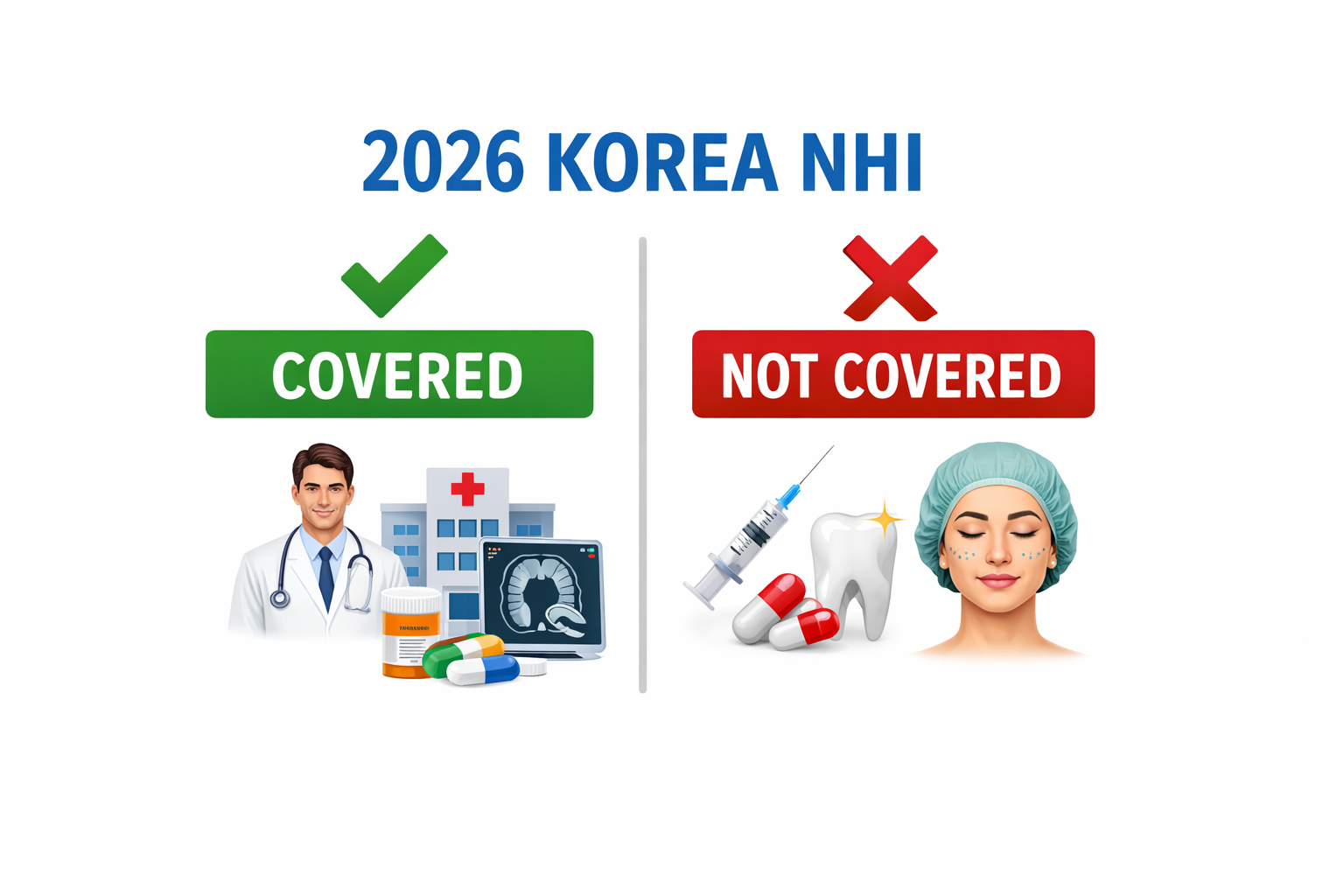
NHI divides all medical services into two hard categories: benefit services (급여 항목) — where NHI pays its share — and non-benefit services (비급여 항목) — where the patient pays 100%. This distinction is the single most important concept for managing healthcare costs in Korea.
Services Covered by NHI (급여 항목)
The following services are recognized as medically necessary by the Korean healthcare system and fall under standard NHI coverage. The patient pays only the co-payment percentage — NHI covers the rest.
- Doctor consultations — internal medicine (내과), surgery (외과), pediatrics (소아과), and most specialties
- Inpatient care — hospitalization, nursing care, standard ward room (일반 병실)
- Emergency treatment (응급 처치) — ER visits at designated emergency centers
- Diagnostic tests — blood tests (혈액검사), X-rays (엑스레이), CT scans (CT), MRI (MRI) when medically indicated
- Prescription medications (처방 의약품) — approved drugs dispensed at pharmacies (약국)
- Chronic disease management — diabetes (당뇨), hypertension (고혈압), and other registered conditions
- Cancer treatment (암 치료) — registered cancer patients pay only 5% co-payment
- National health screenings (국가건강검진) — free biennial general checkups for eligible enrollees
- Physical therapy (물리치료) — when prescribed by a doctor
- Mental health consultations (정신건강의학과) — basic outpatient sessions at clinics
Services NOT Covered by NHI (비급여 항목)
Non-benefit services are billed at the hospital's own standard rate — there is no NHI subsidy, and no co-payment calculation applies. The patient pays the full amount (전액 본인부담).
| Non-Covered Service | Korean Term | Typical Cost Range (KRW) |
|---|---|---|
| Cosmetic surgery (double eyelid, rhinoplasty, etc.) |
성형수술 | 500,000 – 5,000,000+ |
| Dental implants (under age 65) |
치과 임플란트 | 800,000 – 1,500,000 per implant |
| Orthodontics (braces, aligners) |
치아 교정 | 2,000,000 – 5,000,000 |
| Teeth whitening | 치아 미백 | 200,000 – 600,000 |
| Cosmetic injections (Botox, fillers for aesthetics) |
미용 시술 | 100,000 – 500,000 per session |
| Private hospital room (1–2 bed upgrade) |
상급 병실료 | 50,000 – 300,000 per night |
| Unapproved / experimental treatments |
비승인 치료 | Varies widely |
| Health supplements and non-prescribed injections |
건강보조식품 / 비처방 주사 |
Varies widely |
Before agreeing to any procedure, ask the hospital staff directly: "Is this covered under NHI? (이 치료는 건강보험 적용이 되나요?)" If the answer is no, request a written cost estimate (진료비 예상 안내) before proceeding. This is a right available to all patients.
Real Cost Comparison: With vs. Without NHI
To put the difference in practical terms, the table below shows typical out-of-pocket costs at a local clinic for common situations, comparing an uninsured visitor (tourist) versus an enrolled NHI member.
| Medical Situation | No Insurance (Tourist) |
With NHI (Enrolled Resident) |
|---|---|---|
| Cold / flu consultation at a local clinic |
35,000 – 55,000 KRW | 5,000 – 7,000 KRW |
| Physical therapy (1 session) |
40,000 – 60,000 KRW | 8,000 – 12,000 KRW |
| Emergency room (basic visit) |
150,000+ KRW | 40,000 – 60,000 KRW |
| Hospitalization (standard room, per day) |
Full rate billed | 20% of approved cost |
Korea's 2026 NHI (국민건강보험) offers foreign residents genuinely affordable healthcare — but only for covered benefit services (급여 항목). Understanding co-payment rates, identifying non-covered treatments (비급여) before agreeing to them, and keeping premiums paid on time are the three habits that protect both health and visa status in Korea.


