Every spring, yellow dust Korea spring combines with urban pollution to create serious air quality Seoul issues. Knowing how to choose a fine dust mask Korea — especially KF94 — decoding the blaring government emergency alerts, and picking the right air quality app are essential survival skills during the unpredictable spring weather Korea season that catches most foreigners completely off guard.
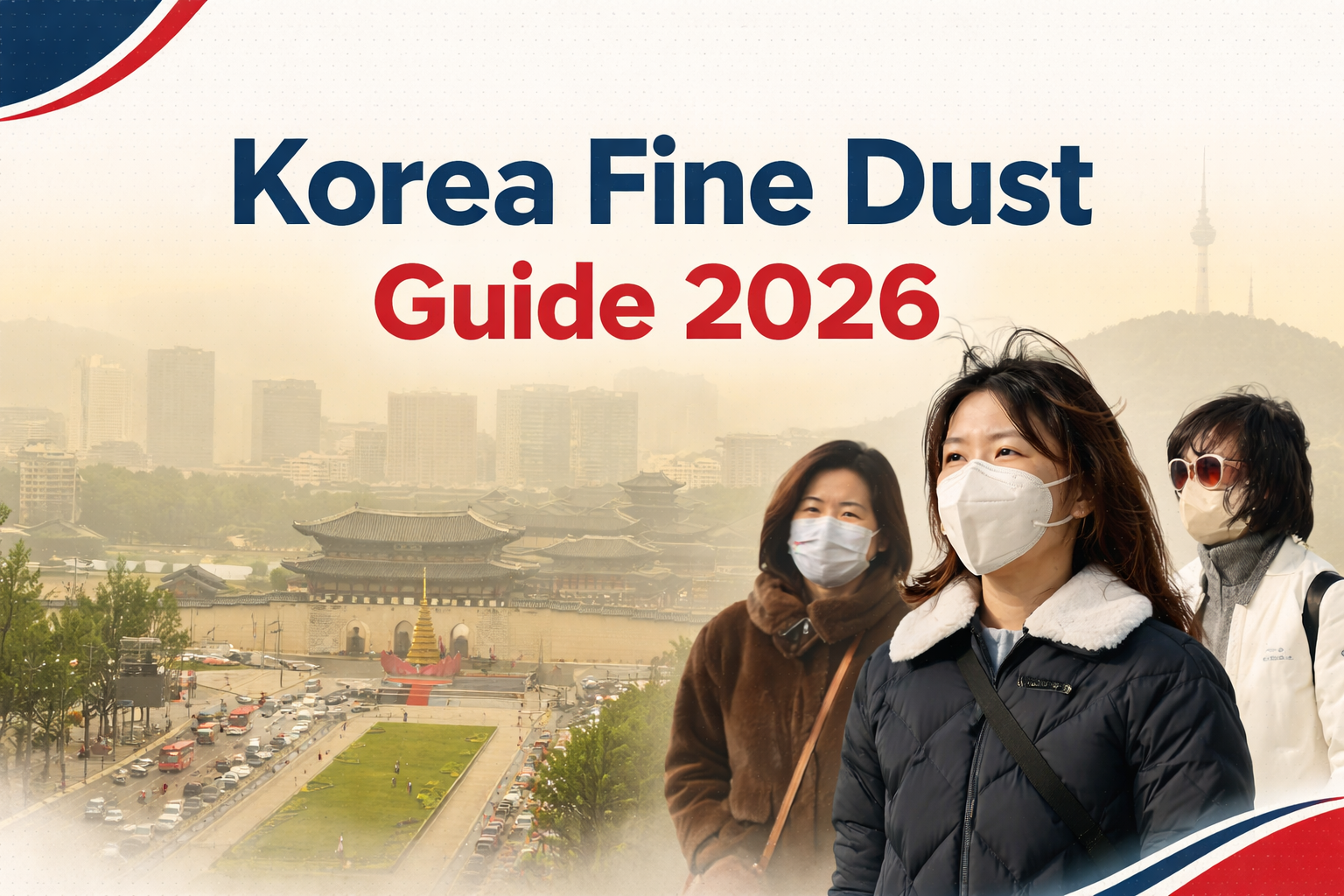
Air Quality in Seoul: How to Read Fine Dust Levels
Every spring, residents across Korea notice the sky turning hazy or yellowish. This is the seasonal combination of yellow dust Korea spring (Hwangsa — sand blown from China's Gobi Desert) and local urban emissions. Together, they cause sharp spikes in air quality Seoul readings that affect everything from commuting decisions to outdoor dining plans.
PM stands for Particulate Matter — microscopic particles suspended in the air. The number indicates size in micrometers (μm). PM10 (미세먼지 ) is the larger particle, irritating the nose and throat. PM2.5 (초미세먼지 ) is 30× smaller than a human hair — it penetrates deep into the lungs and bloodstream, making it significantly more dangerous.
| Level | PM10 — Fine Dust | PM2.5 — Ultra Fine Dust | What to Do |
|---|---|---|---|
| Good | 0 – 30 μg/m³ | 0 – 15 μg/m³ | Outdoor activities safe |
| Normal | 31 – 80 μg/m³ | 16 – 35 μg/m³ | Sensitive groups use caution |
| Bad | 81 – 150 μg/m³ | 36 – 75 μg/m³ | Wear KF94 mask outdoors |
| Very Bad | 151+ μg/m³ | 76+ μg/m³ | Stay indoors. Emergency alerts likely. |
When levels hit Bad or Very Bad, wearing a certified fine dust mask Korea KF94 is highly recommended even for a short walk to the subway. The Seoul Metropolitan Government English Portal publishes real-time air quality data and daily advisories — bookmark it before spring arrives.
Managing pollution-related health costs effectively also means understanding Korea's national health insurance system. The 2026 NHIS Korea Guide: Health Insurance for Foreigners covers how respiratory conditions are treated and reimbursed under the national system.
Fine Dust Mask Korea Guide: KF80 vs KF94 vs KF99
Choosing the correct mask is one of the most important decisions during yellow dust Korea spring season. Korea operates an official national mask certification system called KF (Korea Filter) , independently tested and approved by the Ministry of Food and Drug Safety (MFDS). Unlike generic surgical masks, KF masks are specifically engineered to block fine dust and ultra-fine dust particles.
KF masks are available at pharmacies (약국 ), convenience stores (GS25, CU, 7-Eleven), and supermarkets across Korea. They typically cost between ₩1,000 and ₩3,000 per mask and are sold individually or in packs of 10.
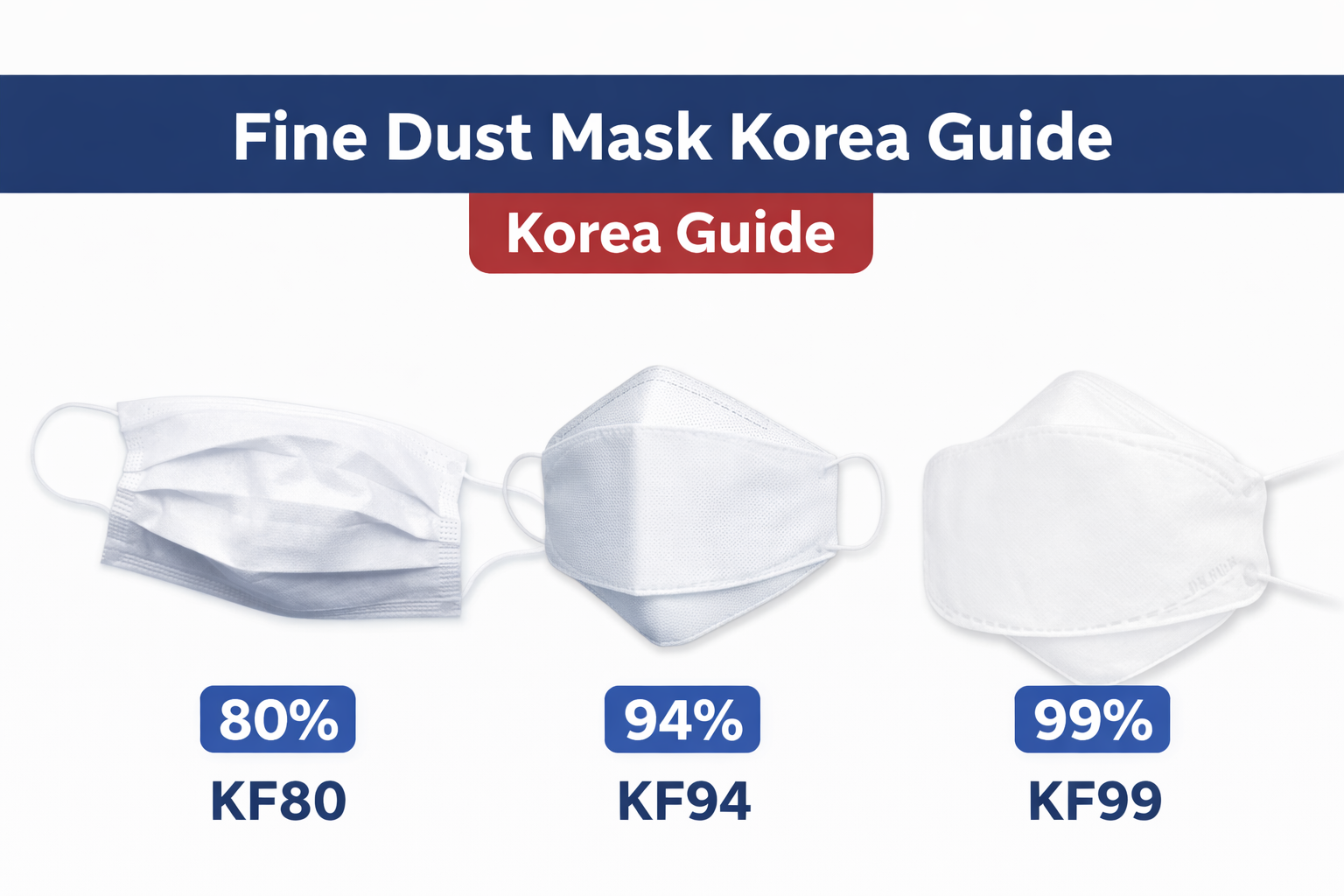
| Mask Type | Filtration Rate | Best Situation | Breathing Comfort | Recommended For |
|---|---|---|---|---|
| KF80 | 80% | Light pollution / Normal days | Easy | Daily commute on Good days |
| KF94 Best Choice | 94% | Typical fine dust days | Balanced | Most foreigners' daily standard |
| KF99 | 99% | Severe pollution / Very Bad days | Hard to breathe | Elderly, respiratory conditions |
The KF94's boat-shaped (3D) design creates an air gap between the mask surface and the face. This means breathing is significantly easier than KF99, while still filtering 94% of ultra-fine PM2.5 particles — compared to roughly 40–60% for a standard surgical mask. The seal around the nose bridge and cheeks is the critical factor: press the metal nose clip firmly before going outside to maximize protection.
Ready to stock up before spring hits?
KF94 masks are available now on Coupang — Korea's largest online retailer. Order today and get same-day or next-day delivery anywhere in Korea.
Buy KF94 Masks on Coupang
이 포스팅은 쿠팡 파트너스 활동의 일환으로, 이에 따른 일정액의 수수료를 제공받습니다.
This post is part of the Coupang Partners program. A small commission may be earned at no extra cost to you.
For updated official seasonal health guidelines, the Ministry of Health and Welfare (English) publishes mask advisories each spring.
Best Apps for Air Quality in Korea: MiseMise vs. AirVisual
Checking pollution levels every morning is a mandatory daily habit for anyone living in Korea during spring. While the MiseMise app is the most downloaded app by locals, its English support remains notoriously incomplete in 2026 — a fact that surprises many newly arrived expats.
Even with a phone set to English, a significant portion of the detailed text, push notifications, and menu labels in MiseMise still display in Korean only. Complaints about this are common on expat forums including Reddit's r/korea and r/SeoulExpats. That said, MiseMise's iconic color-coded face icons require zero language skills to read: a smiling blue face = Good, a frowning orange face = Bad, a gas-mask black face = dangerously toxic. For a quick glance, it works perfectly for anyone.
For foreigners who need fully localized English data and international AQI standards, AirVisual (by IQAir) is the superior alternative. It uses the global AQI (Air Quality Index) scale familiar to Western expats, provides precise health impact descriptions in flawless English, and offers next-day forecasting that is often more accurate for Seoul than MiseMise's government-sourced data.
| Feature | MiseMise | AirVisual (IQAir) | Emergency Ready App |
|---|---|---|---|
| English Support | Partial | Full | Partial |
| Data Standard | Korean CAI | Global AQI (US EPA) | Korean Gov. Data |
| Real-time PM2.5 | Yes | Yes | Yes |
| Push Alerts | Yes | Yes | Yes (official gov.) |
| Hourly Forecast | Yes | Yes | No |
| Best For | Quick color check | Full English analysis | Emergency translation |
Daily Protection Tips for Spring Weather Korea
Living in Korea during yellow dust Korea spring season requires a few practical lifestyle adjustments that go beyond simply wearing a mask. Fine dust particles are small enough to enter homes through window seals, elevator gaps, and ventilation systems — making indoor habits just as critical as outdoor precautions.
Make it the first thing checked after waking up. Open MiseMise or AirVisual. If the air quality Seoul index reads Bad or Very Bad, prepare a KF94 mask, limit outdoor time, and keep windows closed throughout the day.
A fine dust mask Korea KF94 only works when fitted correctly. Press the metal nose clip firmly against the bridge of the nose, then run two fingers around the edge of the mask to check the seal. A gap at the cheek or chin reduces filtration dramatically, even on a KF99. Replace masks after 8 hours of use or when breathing becomes noticeably difficult.
During spring weather Korea season, opening windows carelessly can fill a room with PM2.5 in minutes. Open windows only when the pollution level reads Good or Normal — typically early morning or in the hours immediately following rain.
Air purifiers with HEPA filters are considered essential in Korean homes during spring. Rather than spending ₩500,000 or more to buy one outright, most expats and local residents use a monthly rental service (렌털 ) from brands like Coway or LG. For around ₩20,000 – ₩30,000 per month, a trained technician visits regularly to clean the machine and replace the fine dust filters. This keeps filtration efficiency at 100% without any additional effort — and saves significant upfront cost for newly arrived expats.
Running, cycling, and hiking during Bad or Very Bad air quality days means the lungs process far more fine dust particles per minute than normal breathing. Move workouts indoors or reschedule for evenings when PM2.5 levels typically drop. Many expats in Seoul use their local 구민체육관 (district gym) — an affordable public fitness facility available in every district.
When PM2.5 levels reach critical thresholds during spring, the Korean government sends 재난문자 (Jaenan Munja — Emergency Text Alert) to every smartphone in the affected area simultaneously. The message arrives with an extremely loud siren-like alarm sound — completely different from a regular notification. Newly arrived foreigners who have never experienced this before frequently assume something catastrophic has occurred.
The message is written entirely in Korean and typically reads something like: "[행정안전부] 수도권 초미세먼지 매우나쁨 예보. 외출 자제 및 마스크 착용 바랍니다." Translation: the government is warning that PM2.5 is at Very Bad levels and advising residents to stay indoors and wear a mask. Download the official Emergency Ready App (provided by the Ministry of the Interior and Safety) to receive automatic English translations of these alerts going forward.
Pregnant women, children, the elderly, and anyone with asthma, allergies, or pre-existing respiratory conditions should begin precautions one level earlier than the general guideline. Start wearing a KF94 mask and limiting outdoor time as soon as levels reach Normal — not just when conditions deteriorate to Bad.
Planning outdoor activities around air quality forecasts is also closely connected to dressing appropriately for Korea's unpredictable spring conditions. The Korea Weather in March 2026: Outfits & Survival Guide explains how temperature and pollution levels can both shift dramatically within a single day — and what to carry to handle both.
Spring air quality in Korea changes rapidly, but with daily air quality Seoul checks via MiseMise or AirVisual, a properly fitted KF94 fine dust mask Korea, a Coway or LG rental purifier running indoors, and the Emergency Ready App installed to decode government alerts — surviving yellow dust Korea spring season safely is entirely within reach.


